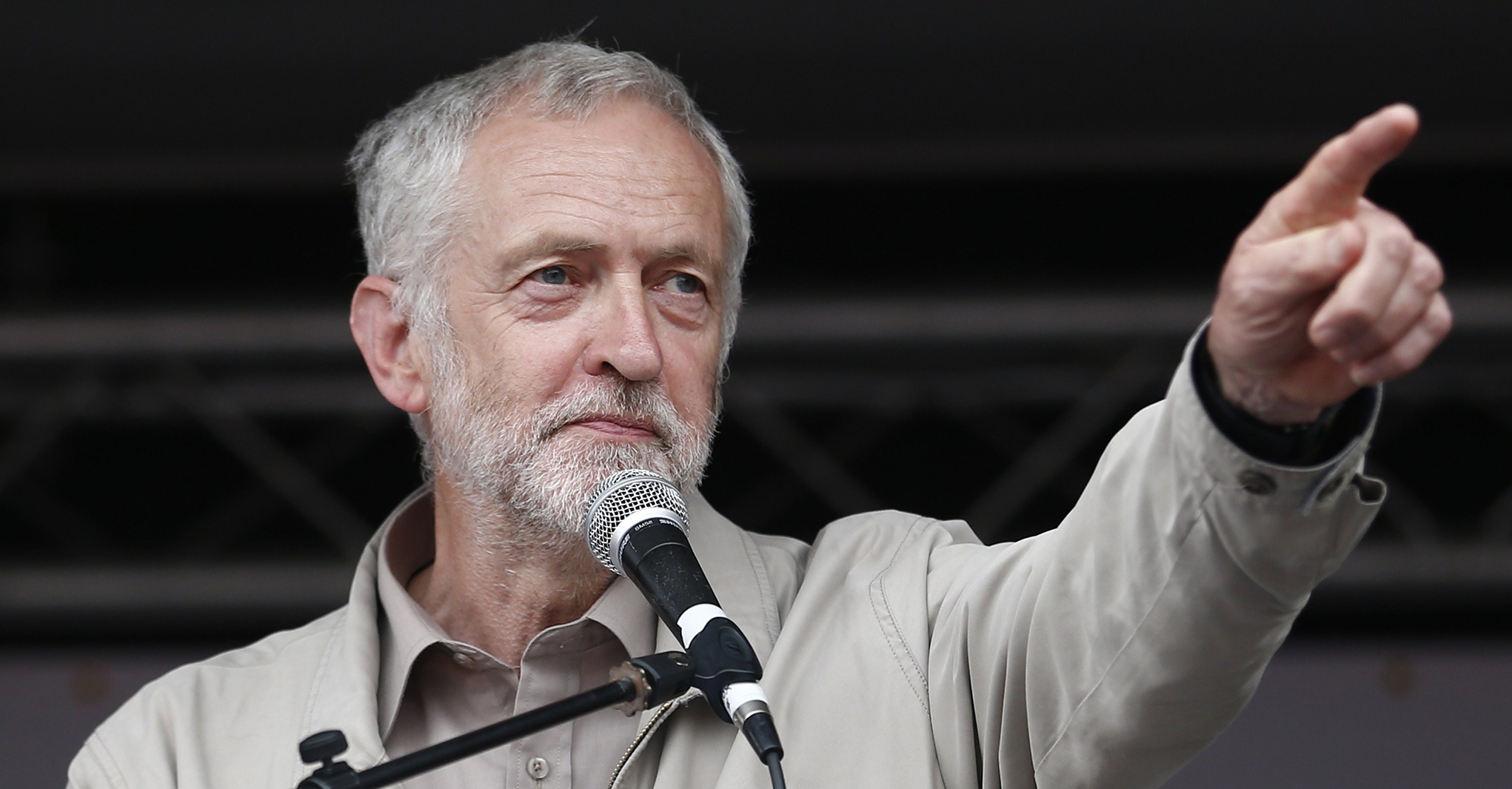
The recent election of Jeremy Corbyn as the new leader of Britain’s Labour Party has spurred a flurry of debate on the Left, particularly as we move forward in the long shadow of this summer’s showdown in Greece and the ultimate failure of anti-austerity SYRIZA to live up to its promise of standing up to Europe’s imposed memoranda. Still, regardless of where we stand on the question of the Labour Party generally, there is no denying that Corbyn’s victory--overwhelming in the first round--has generated massive excitement and mobilized thousands of young people new to politics and seasoned Labour members alike.
And as Europe contends with a refugee and migrant crisis that is, for the most part, self-created through the West’s imperialist agenda, issues like the arts and the state’s role in funding and supporting them weren't the key headline. Yet Corbyn noted that the question was important, and issued a statement on the topic: “The arts are for everybody, not the few; there is creativity in all of us.”
In the statement, Corbyn blasted cuts to the BBC, the failure to get arts funding directly into the hands of performers and educators, and the “ruthlessly instrumentalist” approach of the Tories to assessing the contribution of publicly funded arts and arts education programs to our society. He instead proposed an alternative vision: “We as a Labour party must offer an alternative programme for the arts, both supporting their ability to enrich the cultural lives of hundreds of thousands of people every year across the UK and promoting a feeling of community ownership from which we all benefit.”
Corbyn’s recognition of the arts’ importance should drive us to think about why it is always the case that arts are the first to come under the axe of austerity. Too often, it seems, we internalize the neoliberal line: that the arts, as much as we might like them, are not an essential part of the functioning of society, and that they can be cut in the name of streamlining and lean production. Arts are aesthetic, and not fundamental, in this view. And when faced with the threat of seemingly inevitable cuts, many people quite understandably accept the arts as a sacrifice in order to protect funding for healthcare and food access programs. After all, what person would demand to hold onto their publicly funded symphony if they were told doing so would result in hungry children?
But I think it’s time reassert a different vision of the role that art and arts education plays in society, and to take a decidedly political approach to their growth and defense. Corbyn is absolutely right to demand not only funding for the arts and broadcasting, but also the placement of that funding directly into the hands of the people who best know how to use it: artists, performers, educators. An anti-austerity arts program must also be anti-neoliberal. It must demand democratization of the arts (which first must mean the democratization of funding). This might also be a way to begin to dismantle the heavy NGO-ization of the arts. After all, foundations don’t know what kind of arts working class communities want and need. Board members don’t know the best way for teachers to use arts to bring together immigrant and native-born children. In calling for community ownership, there is embedded a call to take ownership away from the boards of directors.
All in all, an incredibly exciting time for the cultural left in Britain. What will be done with this opportunity? It’s too early to see. What’s critical: there is an alternative to austerity and that alternative can include the arts. In fact, it must. The arts are fundamental for understanding who we are, for coming to see ourselves as political beings. How many people you know were partially radicalized by an album like The Coup’s Kill My Landlord, or by a graphic novel like Marjane Satrapi’s Persepolis? And this is only in addition to the less tangible way that art, and particularly public art--murals, statutes, street music, radio--shape our politics and horizons. Imagine how different the world might look if instead of statues of Columbus in every city, there instead was a statue of local leaders of indigenous resistance to colonization? Imagine if Diego Rivera’s murals in the Detroit Institute of Art, which valorized the industrial workers and the communists, sprung up on every block. Imagine even the importance of the less formal kinds of art in shaping the public consciousness: the quickly scrawled “Black Lives Matter” across the confederate statues and the “Faltan 43” wheatpastes that mix indigenous aesthetics with the political demand for the return of the 43 missing normalistas from Ayotzinapa. “Vivos se los llevaron. Vivos los queremos.” one sign in my neighborhood reads. They were taken alive. We want them alive.
The arts play an important part in shaping our ability to fight back. They, as expressed in songs like Janelle Monae’s “Hell You Talmbout,” help give us collective voice. Most fundamentally, public arts can help establish the existence and dignity of the workers and the marginalized without relying on the support of ruling class patrons.
In other words, what I’d like to suggest is that arts aren’t the first thing to face cuts because they are superfluous. Instead, the targeting of the arts is a strategic ruling class attack meant to undermine our dignity, our humanity, and our ability to fight back. And for that reason, even in this time of crisis, and even when human misery grows in every direction, the arts must be a part of our vision for the future. Because we don’t want to simply survive or exist. We want to live.
So what might a radical left approach to arts policy look like in this country? I’ll write about that in an upcoming post. Stay tuned.