
• Home
    • Manifesto
    • Submissions
    • Editorial
    • Essays
    • Reviews
    • Poetry
    • Interviews
    • Commentary
    • Imagery
    • Prose
    • Audio + Video
    • Classics
  • Publications
  • shop
  • Support
Menu

Red Wedge

Street Address
City, State, Zip
Phone Number

Your Custom Text Here

Red Wedge

  • Home
  • About
    • Manifesto
    • Submissions
  • Features
    • Editorial
    • Essays
    • Reviews
    • Poetry
    • Interviews
    • Commentary
    • Imagery
    • Prose
    • Audio + Video
    • Classics
  • Publications
  • shop
  • Support
10917299_1459483860978078_6410283266695278400_n.jpg

essays

Emory Douglas, Art and Revolution

October 14, 2014 Craig E. Ross
Warning to America (Left), Emory Douglas (Center), Redesigned Black Panther Logo (Right)

Warning to America (Left), Emory Douglas (Center), Redesigned Black Panther Logo (Right)

As a youngster growing up in the San Francisco Bay Area, Emory Douglas was always in and out of youth detention centers. The counselors knew him and knew that he liked to draw. Douglas’s mother ran a state-run concession stand for the disabled at one of these and knew a lot of the probation officers to whom she would talk about Douglas’s talents. [1] Douglas was raised by his mother, who was legally blind and worked hard as a single parent. Downstairs from Douglas lived an artist named Charles Bible who would mass-produce multiple paintings of the same image of Malcolm X every year for anniversary celebrations of Malcolm X’s life. Through talking to Bible, Douglas learned about Bible’s assembly-line production process as well as Bible’s painting technique. This information became very helpful to Douglas when he began doing portrait paintings over the years. Growing up Douglas found artistic influence from the work Charles White whose art Douglas had seen on a calendar as a child at his aunt’s house. [2] While Douglas was in the Youth Authority system, he worked in the print shop at the Youth Training Center. They asked Douglas to design the logo they would use to label materials to be shipped out. This was essentially Douglas’s first commission. [1]

In the youth detention center Douglas worked on mostly landscape art, without social meaning. A year or so after his release, Douglas decided to attend the City College of San Francisco. The counselor at the detention center heard about Douglas’ plan and suggested that he take up art. When Douglas enrolled, a college counselor suggested Douglas major in Commercial Arts. After this, Douglas’ whole idea of going to school became to break into the commercial art field. He developed his graphic design skills to a professional level, and was sent out on various job assignments. He worked at a silk-screen factory where he learned the silk-screen printing process. He also worked a fine wine goblet and silverware store in downtown San Francisco doing layouts as well as cutting and pasting advertisements and preparing signs for store window displays. He attended City College off and on from around 1964 to 1966. City College introduced him to basic graphic design elements such as figure drawing, sketching, illustration drawing, lettering, layout and design, pre-press production, the offset printing process, and the basic animation process. This educational practice also taught Douglas how to critique and evaluate his own work. City College was Douglas’ only academic graphic design training prior to actual on-the-job training.

Douglas attended college at the height of the Civil Rights movement. At this time, commercial art firms were not hiring African-Americans. While attending City College there was only Douglas and sometimes one other black person enrolled in Commercial Art classes and about 20 students per class. During this time there were graphic styles Douglas created which one instructor told him was not commercial enough. After creating a magazine layout similar to EBONY magazine another teacher told Douglas that he had appreciated what Douglas had done, but that it would take another 10 years or so before ideas like Douglas’s would be accepted.[2]

At City College Douglas and other African Americans had begun to define themselves. They went from being called Negros to being called Black or African American. San Francisco (SF) State had one of the first Black Student Unions (BSU) in the country. Douglas and other black students from City College would go out to the San Francisco State BSU because of the political and cultural activity going on there. The SF State BSU had many speakers come through such as Stokely Carmichael, H. Rap Brown, and Sonia Sanchez. When Amiri Baraka was invited by SF States’s Black Studies Dept. to produces theater performances, Douglas asked him if he could create props and backdrops for his plays, and Baraka agreed. During this time, there were student community activists at State who were planning an event to bring Malcolm X’s widow, Betty Shabazz, to the Bay Area. Having known his graphic skills in the Black Arts Movement, these students wanted Douglas to come to a meeting for the event because they wanted him to to do the poster. While at the meeting there was talk about some guys coming over to do security. Douglas did not know these men at the time but they turned out to be none other than Huey Newton and Bobby Seale from the Black Panther Party (BPP). Dressed in leather jackets, blues shirts, berets and black slacks, Newton and Seale were armed when they came to meeting. Fully understanding the gun laws of the time, Newton and Seale appeared ready to defend themselves. It was right after this meeting that Douglas asked how he could join the party.

The first official thing Douglas was asked to work on for the BPP was the Black Panthernewspaper, but he was also asked to redraw the Panther symbol. The Panther symbol the party was using at the time that was big and fat. The BPP wanted to make the Panther symbol smaller to reflect that the party was about serving the underserved and and undernourished. They did not want the panther to look well fed and healthy. The symbol of the Black Panther evolved from a varsity sports team logo in Lowndes County, Alabama. In Lowndes Couty there were extreme conservative right-wing politics and white racists and there was a high illiteracy rate among Whites as well as among African Americans. White racists were able to go to court to get a symbol of a rooster put on the ballot so illiterate whites would know how to vote for the racist party without even being able to read or write. This opened the door for black people to do the same thing. African Americans chose the high school sports mascot of the Black Panther as the symbol to use at the ballot box. [1]
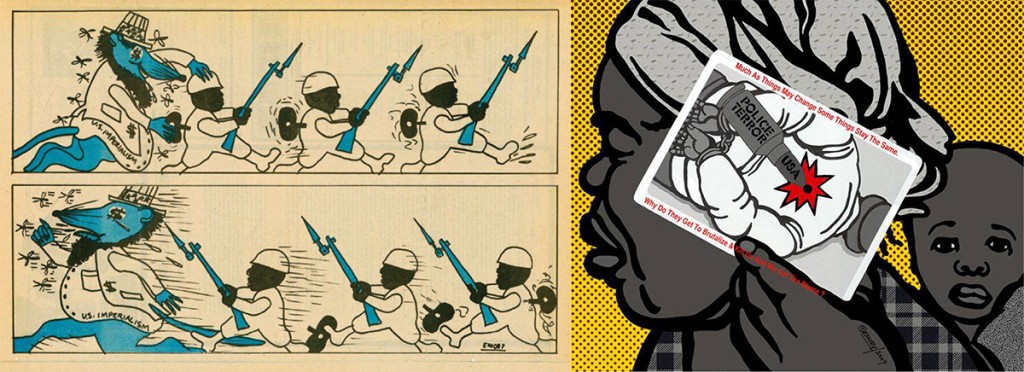
U.S. Imperialism (Left), Police Terror USA (Right)

U.S. Imperialism (Left), Police Terror USA (Right)

All across the country there was there was high levels of frustration of black youth in this country do to police violence, brutality, and murder of people in the black community.Throughout being in the BPP Douglas worked on the BPP newspaper. He started by cutting and pasting the layouts for the newspaper but by the third or fourth issue Douglas became in charge of the newspaper, creating artwork and design which he had learned at the city college. Shortly after Douglas was appointed the Minister of Culture of the Black Panther Party. Douglas’ artwork allowed the community to learn through observation and participation. [3] Graphic art was crucial for communicating the BPP’s message since there were so many illiterate people at this time. [1] As opposed to reading a long article, Douglas’ artwork helped people get the gist of what was being discussed in the newspaper articles through telling stories with his images. [3] Douglas formatted the paper in a way that was more visual with simpler captions and headlines above the paper so that people could understand the message without necessarily reading the long articles. Douglas tried to make the artwork broad enough so that even children could understand it. [1]

Some styles of artwork that Douglas knew he had learned at city college but these were not considered commercial styles. Douglas knew in order to get a job in the capitalist art market he had to learn a more commercial process of art production to build a portfolio to get a job. However, when Douglas began getting more involved with activism and the BPP he began going back to his roots artistically and was able to use his more noncommercial art styles for the use of the Party. His drawing style developed off the aesthetic of woodcuts. Douglas said that he liked woodcuts but the process took too long to do so he developed a style of drawing similar to the aesthetic of woodcuts with brushes, pen and ink, and markers. [3] Politically, Douglas’ art was inspired by the politics and artwork that was being created at the time, particularly the of the Cuban poster artists of OSPAAL (Organization of Solidarity with the People of Asia, Africa and Latin America). He also found influence from the political artwork from China, Vietnam, Palestine, and the Anti-War movement. [2]

Around six o’clock in the morning comrades from the BPP would go out to sell newspapers. They had to be at their selling spots at 7am so along the way comrades would use flour and water to wheat paste old newspaper posters and issues. This really began to define the community as a gallery for art. Working people just trying to get by in the system, who could not afford to go to an ivory tower gallery, could now see these images on their way to work. Workers could see themselves in these images and feel empowered. [1]

What is a Pig? (Left), It’s All The Same (Right)

What is a Pig? (Left), It’s All The Same (Right)

Douglas’s role as Minister of Culture for the BPP involved communicating the party’s message to a community with little experience of formal politics. His drawings and images in the Black Panther newspaper illustrated empowered black people as well as representations of their oppressors, the Pigs. The Pigs stood for everyone from the local police to the president. [4] Bobby Seale and Huey Newton would call police pigs and swine because of the nature of pigs being depicted as fat, sloppy, and wallowing their filth. This idea of pigs being nasty and low natured things translated well into the idea of police as pigs given the nasty way police terrorize the Black community both then and now. Newton and Seale first asked Douglas to draw a pig for the front of the newspaper. There was a cop named Frey who was notorious for harassing people in the community. When Douglas drew Frey as a pig, he included Frey’s badge number in the drawing. He continued this idea by publishing other police badge numbers on his pig illustrations on a ongoing basis. This worked to warn the community of these bad cops but also to expose the police and let them know that people were watching them. After this, Douglas’s pig character took on a life of its own. He began to draw from his commercial art experience of critiquing his own work and decided to start illustrating his pigs differently. The pigs still displayed actual officer badge numbers but now they wore pants and were standing up on two hooves with flies flying around them. These anthropomorphic pig illustrations became the iconic figure of “The Pig” still used in anti-police and revolutionary rhetoric, music, and art today.

At the height of the paper the BPP was printing about 100,000 papers or more weekly, each being read by three or four individuals on average so they had a readership of 400,000. The papers were distributed to Harlem, all the different chapters on the East Coast, and all over the South. Also, the paper had teachers and labor unions who would pick up bundles as well as libraries and churches. Then there was also international distribution from the anti-war dissidents in Canada, Europe, Scandinavia to the Chinese, Korean, and Cuban governments requesting the paper. All the while the American government was using any means necessary to destroy the newspaper. They would wet them in transit to make them unreadable, delay distribution, and put pressure on the paper. The US government recognized that The Black Panther newspaper was a powerful tool for educating, informing and enlightening the people and saw it as a threat to the authority of the ruling class. COINTELPRO (the FBI’s Counter Intelligence Program) was even researching a way to put a feces smell on the newspaper so that when people would read it the paper would reek of feces. [1]

The purpose of the BPP newspaper was to tell their own story of struggle outside of the distorted mainstream press about events, concerns, as well as stories of struggle from solidarity groups all over the world. The corporate media distortedly depicted the BPP as hoodlums and thugs whose only concern was violence and guns. This was far from the truth. Not everyone in the BPP even carried guns, only those in the party who were assigned to. The BPP also carried guns in accordance to the laws and constitution at that time in order to protect their homes, property, and community from the predators of the US government. The BPP were not “thugs” or “outlaws” as often depicted. They were a party dedicated to revolution with many social programs such as health clinics and breakfast programs.

The party was able to expose an educate people to what the government was not doing in regards to the breakfast program. The BPP was feeding more hungry children than the US government. The BPP was also concerned with educating and providing preventative healthcare to people as well as free health clinics available staffed with accredited professional doctors and nurses. Also the BPP set up free bus to prisons programs which would help transport families and friends to visit their loved one who were incarcerated. The success of the BPP is that it lasted as long as it did in the belly of the beast [3].

Though he continued to produce art, up until 2007 Douglas had worked for two decades as the pre-press manager for his local newspaper, the Sun Reporter. In 2007 with the publication a large-format art book and an accompanying retrospective at MOCA in Los Angeles, Douglas began to receive the attention from the art world that he deserves. [4] Even at his age of 71, Douglas continues to create politically charged revolutionary art. In late 2012, Douglas met with the Zapatistas and local artists in the Mexican state of Chiapas in an artist residency initiated by Caleb Duarte from EDELO (En Donde Era La ONU). During this residency, Douglas along with local artists from Chiapas created and art exhibition as well as the Zapantera Negra which was a single-run magazine of 20,000 full-color copies that merged the powerful imagery and layout style of Emory Douglas with the visions and voices of the Zapatista painters and embroidery collectives. [5]

Douglas believes that art has to expose the issues that concern human beings and people who are being oppressed. Art must be able to communicate with people and be a reflection of their desires and concerns in order to be relevant in relationship to change. [3] As artists and revolutionaries, we have a lot we can learn from Emory Douglas about art, politics, and communication, in the continuous struggle for human liberation.

Works cited

  1. Roberts, Shaun, and Emory Douglas. “Emory Douglas.” Juxtapoz Mar. 2011: 40-57. Print.
  2. Daniel, Jon. “Four Corners – an Interview with Emory Douglas.” Graphics, Digital, Interior, Print, Retail, Design News & Jobs. Design Week, 21 July 2014. Web. 18 Sept. 2014.
  3. “Emory Douglas: The Black Panther Party and Revolutionary Art.” YouTube. Angola 3 News, 9 Nov. 2009. Web. 18 Sept. 2014.
  4. Rayner, Alex, and Emory Douglas. “Fight the Power: Alex Rayner Meets the Former Black Panthers’ Minister of Culture.” The Guardian: Art & Design. The Guardian, 24 Oct. 2008. Web. 18 Sept. 2014.
  5. Duarte, Caleb. “The Black Panthers and the Zapatistas: An Encounter.” Kickstarter. EDELO, 17 Oct. 2012. Web. 18 Sept. 2014.

Craig E. Ross is an artist and radical living in Carbondale, Illinois. He is an editor at Red Wedge.

← The Theory and Appeal of Giant MonstersIn Defense of Artistic Autonomy →

WINTER ISSUE

download (3).jpeg

Most Recent

Featured
the-black-cultural-front.jpg
November 8, 2020
Listening for Mrs. Lynch: Left Culture as a Mass Matter
November 8, 2020
Read more →
November 8, 2020
The Man Who Bridged Time
September 14, 2020
The Man Who Bridged Time
September 14, 2020
Read more →
September 14, 2020
Dorohedoro through the Lens of Kafka and Marx
September 11, 2020
Dorohedoro through the Lens of Kafka and Marx
September 11, 2020
Read more →
September 11, 2020
Salad Against Fascism
May 14, 2020
Salad Against Fascism
May 14, 2020

In the plague days there will be sun / and wind blowing clouds across, not enough rain / to fill the reservoir up, and bright yellow flowers: / spindling dandelions, saffron ultraviolet / reaching for the daylight, and closed tight at dusk, / against fascism.

Read more →
May 14, 2020
Neil Davidson, Cultural Theorist: A Personal Reminiscence
May 6, 2020
Neil Davidson, Cultural Theorist: A Personal Reminiscence
May 6, 2020

One of the great Marxist thinkers and organizers of the last century has just departed the mortal coil. My purpose in this reminiscence is to shine a light on one of Neil Davidson’s less well-known qualities, his work as a cultural theorist and critic. Neil was a regular contributor to Red Wedge and appeared on a number of our panels at Historical Materialism conferences. He acted as a mentor to a number of current and former members of the Red Wedge editorial collective and its offshoots.

Read more →
May 6, 2020
The Left Must Act Now
April 29, 2020
The Left Must Act Now
April 29, 2020

Donald Trump, the President of the United States, has called for the “liberation” of states under scientifically based public health quarantines. This call encourages his rabid right-wing base toward further extremism. It can and will lead to thousands of deaths. The far right is already breaking quarantine, blockading hospitals, and calling for the trading of millions of lives for “the economy.” There should be no doubt of their fascist and near fascist politics. Right-wing demonstrators were seen, among other things, holding up antisemitic signs. But even mainstream moderate politicians are moving to prematurely “open” parts of the economy -- as with the recent opening of marinas in the Northeast. Trump’s call is essentially an exterminationist call to a fascist base (despite recent equivocation over Georgia).

Read more →
April 29, 2020
Corona Requiem + Other Poems
April 23, 2020
Corona Requiem + Other Poems
April 23, 2020

From all angers, pulses confidential / on the monitors, and all the beeps, / pray to die within your blessed sleep, / all the bread and oranges essential

Read more →
April 23, 2020
A Party of Our Own
April 14, 2020
A Party of Our Own
April 14, 2020

The marginalization and removal of Bernie Sanders in the Democratic Party primary has once again proven that the party is inherently hostile to its working-class “base.” Thousands across the country are rightly concluding that we need our own independent socialist working class party. But how should we go about furthering this break? There are those who preach imprudent patience. There are comrades who argue that we have to wait for objective conditions to ripen further. There are those who argue against a “premature break” with the Democratic Party. And there are many more who are simply uncertain about how to proceed. Reaching this point during a devastating pandemic and economic crisis further complicates but underlines the urgency of this discussion. The following is in no way conclusive but is meant as a contribution against bleak passivity. 

Read more →
April 14, 2020
Under an Alien Sky
April 9, 2020
Under an Alien Sky
April 9, 2020

We are beset on all sides by disturbances of what the ancient poet-philosopher Lucretius called “an alien sky.” The Covid-19 pandemic is felt by all of us as a presence, a presence of that which should not, which cannot be—inasmuch as our ordinary perceptions define what can and cannot be. It sticks out like a sore, a wound, sudden and without warning causing even the bravest and strongest to groan. Our lives were moving right along, certainly already beset by intrusions into a billion little homeostases, when suddenly it all came crashing down. Before horror, we have felt a fascination with the very strangeness of it all, this thing which should not be that has arrived on our doorstep.

Read more →
April 9, 2020
Virus as Crisis/Crisis as Virus
April 7, 2020
Virus as Crisis/Crisis as Virus
April 7, 2020

When is a virus more than a virus? There is one virus, the novel coronavirus that is leaving thousands of dead in its wake. This is the physical virus at the base of the bigger crisis now emerging across the globe. The other virus is more abstract. It is the effect of this pandemic on human populations, on bodies, on selves, dissolved into the abyss of mortality. It is the social virus, the virus disrupting the social and economic system in which we live and move and have our being. It is virus-as-crisis, the limits of the system of social relations now being tested to their breaking point. It is manifested in the chaotic events of each day, when hospitals are overwhelmed, normal life is disrupted by social distancing, and the stock market crashes in a drama dwarfing 1929. This is the broader crisis, the Crisis. The one which defines the entirety of our lives and the future of our species. It is a crisis of capitalism as a set of social property relations, as a means of governing populations, as a means of determining what is and is not meaningful.

Read more →
April 7, 2020
Bad Moon Rising: Racism, Anti-Semitism + the Toxic Bernie Bro Trope
March 9, 2020
Bad Moon Rising: Racism, Anti-Semitism + the Toxic Bernie Bro Trope
March 9, 2020

Yet “toxicity” is not a floating signifier. In the era of Covid-19 and anxious preppers, virus metaphors having become part of the everyday parlance of information technology with its disposability of human beings through the logic of the social industry. “Toxicity,” on one hand, could be shorn of meaning. On the other hand, it can be seen as going beyond de-humanization in order to render a human being as a walking contagion…

Read more →
March 9, 2020
Winter 2020 * Partially Automated Dystopias + Utopias
February 18, 2020
Winter 2020 * Partially Automated Dystopias + Utopias
February 18, 2020

Initially this online issue was to focus primarily on the intersections of socialist politics, technology, and culture. While the issue still does that it has evolved to include further questions of current left-cultural praxis.

Read more →
February 18, 2020
A Partial + Schematic History of Red Wedge
February 18, 2020
A Partial + Schematic History of Red Wedge
February 18, 2020

Red Wedge (RW) was started in 2012 by a group of (then) ISO (International Socialist Organization - US) comrades around Alexander Billet, Brit Schulte and others. From the beginning there was a commitment to, tension and dialectic between, RW’s desire to play a modest role helping develop the actual production of socialist, left-wing, and working-class art, and its role reckoning on the socialist theory of art.

Read more →
February 18, 2020
Socialist Irrealism vs. Capitalist Realism
February 18, 2020
Socialist Irrealism vs. Capitalist Realism
February 18, 2020

The default cultural logic of neoliberalism and the political center is capitalist realism. In response the cultural logic of working-class emancipation (socialism) is critical irrealism. The ir – or no – of critical irealism is opposed to a particular kind of realism. Therefore, we should examine it more closely.

Read more →
February 18, 2020
In its Right Place: Critique in the age of Spotification
February 18, 2020
In its Right Place: Critique in the age of Spotification
February 18, 2020

In the age of Spotification, music has been decommodified in appearance. Of course even at the height of commodification it retained its use value “aura”; its metaphysical subtleties and theological niceties have always/already been there. But it is now a time in which music serves a different social purpose. In a sense, to play on Marx’s “collective labourer”, there is an emergent “collective listener”, predicated upon th

Read more →
February 18, 2020
Naked Souls: Imposition and "Nudity" in the Internet Age
February 18, 2020
Naked Souls: Imposition and "Nudity" in the Internet Age
February 18, 2020

At the confluence of the internet age and the #MeToo movement, revisiting John Berger's book Ways of Seeing and its discussion of nakedness verses nudity is a conversation that needs to be had.  Not only because he articulated the predominance of the male gaze and discussions of power, but because he referenced Walter Benjamin's Art in the Mechanical Age.  Namely that, through reproduction, when art is removed from its intended location of contact with the public, it takes on different meanings through recontextualization, -- the intrinsic location of artwork lending some of the meaning overall (part of the psychological pilgrimage to approaching art). 

Read more →
February 18, 2020
The Formless Monstrosity: Recent Trends in Horror
February 18, 2020
The Formless Monstrosity: Recent Trends in Horror
February 18, 2020

In an October 2017 piece “How We Ended Up in the Golden Age of Horror Movies”, Scott Meslow notes that the history of horror films has been one of keeping the lights on in Hollywood while receiving no respect from the studios. Director Mike Flanagan recalls endless “eye rolls” at pitch meetings from executives who balked at any attempt to make a serious film in the horror genre—capital’s representatives wanted the equivalent of fast food with “empty calories” making up the bulk of their horror repertoire. What then explains this change of heart in recent years, with studios churning out critically acclaimed films such as Get Out (2017) and Hereditary (2018)? The most immediate cause is to be found in smaller studios producing critically-acclaimed box office hits with minuscule budgets—an attractive model in the era of $100 million dollar blockbusters.

Read more →
February 18, 2020
Realism Modernism, + the Specter of Trotsky (part 3)
February 18, 2020
Realism Modernism, + the Specter of Trotsky (part 3)
February 18, 2020

In particular, I am concerned here to refocus away from the hitherto ‘ghostly’ character of Trotsky’s presence in this article to date and allow him to speak in the same way as Lukacs and Greenberg on their respective themes in parts 1 and 2. In particular, I want to introduce Trotsky’s concept - virtually unknown during the historical debates surveyed in Parts 1 and 2 - which he called “the ‘law’ of uneven and combined development”(UCD), the current widespread deployment of which has done so much to revive and consolidate Trotsky’s reputation as an important Marxist theorist, in addition to that of revolutionary strategist.

Read more →
February 18, 2020
Lil Nas X: Old Town Rodeo for a New Power Generation
February 18, 2020
Lil Nas X: Old Town Rodeo for a New Power Generation
February 18, 2020

Lil Nas X burst onto the music scene--in retrospect, an inevitable star--with the Tik-Tok viral single Old Town Road in xx 2019. The song reached number-one status on Billboard 100 and occupied the position for 19 weeks, the longest of any number-one hit in sixty-one years.

Read more →
February 18, 2020
Hackers + Slackers: Encounters with Science + Technology in 90s Cinema
February 18, 2020
Hackers + Slackers: Encounters with Science + Technology in 90s Cinema
February 18, 2020

In the 1992 science fiction film The Lawnmower Man, a mentally challenged groundskeeper named Jobe becomes hyper-intelligent though experimental virtual reality treatments. As his intellect evolves, he develops telepathic and telekinetic abilities. By the end of the movie, Jobe transforms into pure energy, no longer requiring his physical form and completely merging with the virtual realm, claiming that his “birth cry will be the sound of every phone on this planet ringing in unison.”

Read more →
February 18, 2020
Stafford Beer: Eudemony, Viability and Autonomy
February 18, 2020
Stafford Beer: Eudemony, Viability and Autonomy
February 18, 2020

What if the global economy were structured, not to send wealth into the hands of a tiny group of oligarchs, but rather to ensure the best possible lives for everyone, ensuring that people lived fulfilling lives free from want, engaged in activities that interested them and engaged them, enabling them to pursue their own interests alongside working for the common good? What if people worked in co-operatives, coordinated together to meet the needs of society, organized from below rather than from above, with the workers themselves as the beneficiaries of their labor? What if the global economy elevated workers instead of immiserating them?

Read more →
February 18, 2020
Don't Look Back: 1980s Music + The Counterculture
February 18, 2020
Don't Look Back: 1980s Music + The Counterculture
February 18, 2020

n the perma-retro that constitutes contemporary life, the 80s is a montage from Wall Street (1987) St Elmo’s Fire (1985) and Desperately Seeking Susan (1985): a sequence of wet-gel, shoulder pads and designer suits backed by bombastically upbeat music. Even 80s revisits like Wolf of Wall Street (2013) and Black Mirror’s San Junipero (2016) don’t go far from the format. We don’t often speak of right-wing utopianism – more of its “cold stream” realism – but the enduring fantasies of the 80s exemplified just that. For all both Wall Street and Wolf of Wall Street’s acknowledgement of 80s’ corruption, cruelty and volatility, it is the class-A rush of acquisition, consumption and social contract-busting that stays with the viewer. And the same is true of book and film of Bonfire of the Vanities and even American Psycho.

Read more →
February 18, 2020
The Portions of the Day: Screen-Time + Time Discipline
February 18, 2020
The Portions of the Day: Screen-Time + Time Discipline
February 18, 2020

Though the notion of cursing sundials seems quaint today, these lamentations, attributed to the Roman playwright Plautus, speak to an anxiety about the draining nature of time measurement that still seems prescient. In 1967, over two centuries after Plautus died, the Marxist historian E.P. Thompson would take time out of the hands of poets and put it into the hands of historians and anthropologists with his essay “Time, Work-Discipline, and Industrial Capitalism” where he traced the relation of “clock-time” through the emergence of waged labour in the industrial revolution:

Read more →
February 18, 2020
Memez
February 18, 2020
Memez
February 18, 2020

INGA ORTIZ [Assassin #6] stood above the corpse of Governor Irina Blythe-Pillsworth. The governor’s eyes were staring up at the gilded bathroom ceiling in the Grand City Hotel. They betrayed none of the horror they’d shown when she’d turned a corner, just moments ago, and saw an Employed leaning against a marble sink.

Read more →
February 18, 2020
Gentrification Is Coming + There Will Be Cupcakes
February 18, 2020
Gentrification Is Coming + There Will Be Cupcakes
February 18, 2020

A point of convergence / Collision of the fluid kind / Turbulent / Where reflection is muddled / And the spirit murky / These are all questions. 

Read more →
February 18, 2020
Water found on distant planet
February 18, 2020
Water found on distant planet
February 18, 2020

Water found on distant planet. / I want to go there. / Free of embarrassment, none that I know there.

Read more →
February 18, 2020
Memorandum for HM Government FAO cabinet meeting re Commodity Fetish Outbreak
February 18, 2020
Memorandum for HM Government FAO cabinet meeting re Commodity Fetish Outbreak
February 18, 2020

This document is a short history and explanation of the Commodity Fetishism Outbreak (CFO)[1] with an inventory of significant actors plus outline of potential courses of action available to HM Government.

Read more →
February 18, 2020
A Worker Reads Graphic Novels
January 2, 2020
A Worker Reads Graphic Novels
January 2, 2020

“Normie” socialists, having largely lost recent political arguments in the new socialist movement – particularly in the righteous backlash against Angela Nagle – seem to be redoubling their efforts on the cultural front. Jacobin recently posted two highly questionable articles along these lines; John Halle’s “In Defense of Kenny G” and Alexander Dunst’s “Graphic Novels Are Comic Books, But Gentrified.”

Read more →
January 2, 2020
An Announcement from Red Wedge – Can’t Stop, Won’t Stop
December 27, 2019
An Announcement from Red Wedge – Can’t Stop, Won’t Stop
December 27, 2019

Following the new issue, Red Wedge will be moving, perhaps temporarily into the type of institution it was in its early years, that is primarily an online publication, with - we hope - regular content, blogs, film and music criticism and so on. Contributions are welcome! Whether we do another full-fledged issue, print or online, later in 2020 or beyond, depends on our capacities. Yet we feel we have been remarkably effective, historically at cultivating and curating unique online content, both non-fiction and fiction, both words and images. Indeed, with a massive archive of written work dating back almost a decade, we find readers continually reading articles from the website from many years ago. We encourage newer readers to dive into the Red Wedge rabbit-hole, featuring work from the likes of Ashley Bohrer, David Renton, Michel Lowy and many more of today’s great minds of the far left. We have plans to, time permitted, make the archive more user friendly, but even as it stands, there is a plethora of material that, in a sense, gives an historiography of the Left and culture since 2012.

Read more →
December 27, 2019
No results found
Red Wedge #6: In Defense of Transgression Buy on Amazon
RW-MAY1-ONLINE-SPLASH.jpg
Become a Red Wedge Patron

Become a Red Wedge Patron

Donate
Thank you!
Summary Block
This block is invalid. Please check the block settings and try again.
Featured
Aenean eu leo Quam
Aenean eu leo Quam

Quisque iaculis facilisis lacinia. Mauris euismod pellentesque tellus sit amet mollis.

Read more →

about Red Wedge

become a sustainer

submissions

buy commodities

contact us

No results found
Subscribe