
We made this song in memory of Larry Jackson, We made this song for LaKiza.
We made this song for the community.
We made this song to heal.
We made this song to pressure the judge to NOT DISMISS THE CASE.
Phoenix From Rain
"To have dominion was not to knock out, downpress, bruise, but to understand, to love, make at home." — Toni Cade Bambara, The Salt Eaters
I have a lot of things I think
I say. Now is the time to act.
Now is the time to act
by speaking. Now is the time
to speak by evicting the words
that have choked me. Now the words
John Reed Clubs and Proletarian Art (part 1)
I want to address the theme of Proletarian and Revolutionary Art in the United States between 1928 and 1935; that is to say in the years of the so-called Third Period line in the tactics of the international Communist movement. Although the terms “Proletarian Art” and “Revolutionary Art” were often used seemingly interchangeably at this time — or even used in combination — they are not synonymous, and I will argue that the distinction points up tensions between different forms of art practice produced in the Communist Party’s orbit and to important intellectual confusions.
Before analyzing the theory and practice of this art and the reasons for its emergence and decline, something needs to be said about its genealogy.
Read moreDivaCup Democracy: The Saga of Bloody Trump

If there were ever a walking, talking, bloviating illustration of the American political tragicomedy, it is Donald Trump. The man who very well may win the Republican nomination for president due to his bottomless cash reserves is, for roughly the same reason, given carte blanche to say more or less whatever he wants under the guise of "it's what everyone is thinking." It bears pointing out that very few of his comments or platforms are "what everyone is thinking." A more apt description might be "what the anxious and insecure white male middle class is thinking."
This is likely why the art of Sarah Levy went so phenomenally viral during the month of September. The socialist, feminist and artist's rendition of the duck-faced one was a clever inversion of his words about Fox News' Megyn Kelly's menstrual cycle.
Read moreOn Bemusement Parks and Pig-Fucking: Ten Questions About Critical Distance
To hell with Banksy. The truly visionary artist of British pop culture is Charlie Brooker.
The iconic anonymous artist’s massive Dismaland project closed within days of an unauthorized biography's claim that British Prime Minister David Cameron once put his privates in the mouth of a dead pig during his time at Oxford. By itself, the incident would have been hilarious enough and would have certainly sent the UK tabloids into a tizzy. But the revelations regarding Cameron were made all the more tantalizing and just straight up weird by their proximity to Charlie Brooker’s Twilight Zone for the 21st century Black Mirror.
Read moreMarionette Divorce (The Present Condition of Russia)
The enemy masses at ballet practice -
In this new theatre of red Madonnas,
military poetry is seen dimly glimmering
through the exquisite hostility of war.
This poetry has erred towards
emblems of superficial pathos.
A Festival of Color and Glam
Diversity and tolerance were major elements of this year’s Afropunk in New York City. It was a kaleidoscope of musical styles that oscillated between rap and electronic dance music sampling heavily from traditional African drumbeats and popular music. During the weekend of 22-23 August 2015, Afropunk took pace at Commodore Barry Park in Brooklyn — a park wedged between the Brooklyn Navy Yard and Clinton Hill’s predominantly black and working class community.
For two days, musicians, artists, and their spectators engaged in a festival with quirky and alternative people from various walks of life. One could find an attendee with green hair, metal chains, and nothing else.
Read moreRevolution and the Avant-Garde
Chto delat? (Tsaplya, Oleynikov and Vilensky), Angry Sandwichpeople or In Praise of Dialectics, 2005, video, 8min 5 sec, stills.
In his ambitious defense of a contemporary avant-garde conceived as an open-ended research program, critic and theorist John Roberts weaves together a theoretically heady prescription of its conceptual methodology, analyses of several exemplary praxes that adapted pertinent avant-gardist questions to their own social conditions, and an account of dynamics of art production and reception in late-capitalism that seem to demand the advance of a contemporary avant-garde.
Roberts inevitably confronts the nearly hundred-year-old conceptual problems embedded in the historical avant-garde, along with the plethora of pertinent critical and art historical scholarship that has emerged in the meantime.
Read moreAssata Taught Me Poetry (part 2)
Alongside the poems that interrupt, enrich, and prompt us to reflect on her autobiographical narrative, Assata Shakur also includes in her text a number of less lyrical writing samples, including speeches she reads at trial to contest her accusers, and political statements that she issues from prison. Even behind walls and in chains, her voice continues to resonate, as it resonates still today, from exile in Cuba.
Addressed to “Black brothers, Black sisters,” Shakur’s statement from prison “To My People” makes clear that while her project is anchored in the struggles facing African Americans, the enemy is to be understood in political and in class terms.
Read moreNo More Daydreaming?
Jefferson Airplane circa 1970
“Look what's happening out in the streets
Got a revolution! Got to revolution!
Hey I'm dancing down the streets
Got a revolution! Got to revolution!”
The lyrics to the Jefferson Airplane’s “Volunteers” boomed out of the oversized speakers set in the 2nd floor window of the 6th Sense Boutique in College Park, Maryland. Below were rows of grim faced police in riot gear faced thousands of University of Maryland students occupying Route 1, the main road through College Park.
Read moreConstructivism: The Avant-Garde and the Russian Revolution
Constructivism presents a particular problem for contemporary artists who must produce art within capitalism. The entire meaning of Constructivism is bound up with the period of socialist construction (such as it was) in the USSR. Without the revolution Constructivism was not possible. This explains why contemporary anti-capitalist artists tend to look to different models — Brecht, Dada, Heartfield, Fluxus, Situationism, Godard, Fo, Hip Hop, punk, folk music, Surrealism, the Mexican muralists, etc. We have no socialist world in which to construct our art. Moreover, the ideological origins of Constructivism, between the 1905 and 1917 revolutions, are problematic for an over-determined “Marxist” conception of art. Many of the artists who gave birth to the most important art movement in Marxist history were essentially mystics.
Read moreVictor Serge: On the Borders of Victory and Defeat
Victor Serge (left), Benjamin Péret, Remedios Varo, and André Breton
For Victor Serge, there was no life possible that could be separated from a commitment to the revolutionary struggle. And his life-spanned the first World War to the Russian Revolution, the rise of fascism in Germany and Spain, the rise of Stalin and the cataclysm of World War II. Serge lived through the heights of revolutionary triumph to the darkness of what he termed “the midnight of the century.” That commitment ranged from involvement in anarchism, syndicalism, Bolshevism, Trotskyism and what is best described as socialist humanism. Serge's revolutionary career saw him take up such varied roles as organizer, journalist, theoretician, militant, soldier, translator, a prisoner under at least five different regimes, secret agent, and a historian.
Read moreOn the Suicide of the Refugee W.B.
I am told that you raised your hand against yourself
Anticipating the butcher.
After eight years of exile, observing the rise of the enemy
Then at last, brought up against an impassable frontier
You passed, they say, a passable one.
Sovereign Imagination: The Art of Leonard Peltier
Leonard Peltier could not be present at the exhibition of his artwork at the second Indigenous Fine Arts Market (IFAM) in Santa Fe, NM, held on August 20-22, because he's been incarcerated in the U.S. federal penitentiary system for the last 40 years. He's currently in Coleman (Florida), a known “gang prison,” a brutal and violent place subject to frequent lockdowns lasting not uncommonly for as long as a month.
Maybe next year?
Read moreAssata Taught Me Poetry (part 1)
Among the more strikingly radical figures invoked by #BlackLivesMatter has been exiled Black revolutionary Assata Shakur. The former Black Panther, dubiously convicted “cop killer,” and wanted “terrorist” fugitive has become a recognized emblem in the movement, even though Assata herself, underground in Cuba, remains publicly quiet regarding the recent upsurge. Nonetheless, at demonstrations across the US, lines from Shakur’s autobiography have been turned into a kind of movement mantra.
Read moreBlack Throated Sparrow
Who cares about who gets caught jumping
over someone else’s fence?
Mutts will bark.
Porch lights will sweep small critters
into another darkness.
Big deal.
Nothing will be stolen.
Theatre For the People: A Roundtable With Oracle Productions
Oracle Productions' version of Bertolt Brecht's The Mother
One could be easily forgiven for believing that theater is indeed “dead.” Every medium of culture and creativity struggles with issues of relevance and vitality, but the common conception of theater in particular seems to be one that has been most flagrantly geared merely toward parting tourists with their money. Of course, it’s not entirely true; the reality is far more complex. But the fact remains that there appears to be a gap between what we learn the live performing arts once were (or could be) and their present anodyne state. How is a play supposed to be relevant to working people? How can it be when it costs an arm and a leg just to go to one?
Read moreWhen Hip-Hop Hits the Streets
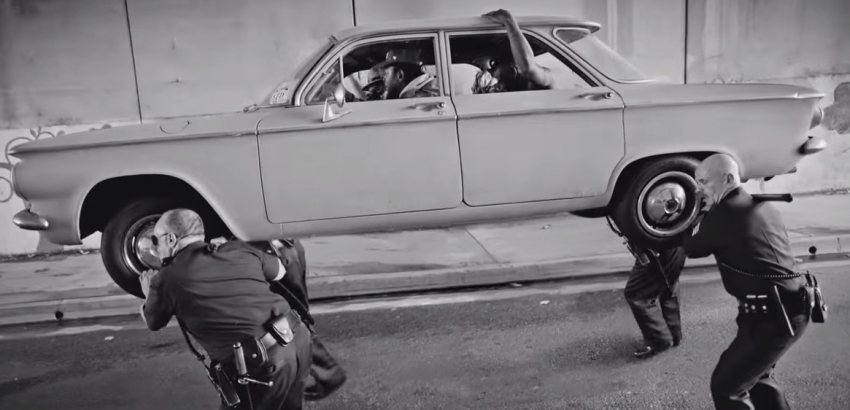
Scene from the video for Kendrick Lamar's "Alright"
It’s been a year since the death of Michael Brown, a year since the rebellion in Ferguson, a year since the Black Lives Matter movement began to shift the conversation in just about every avenue of American life. That shift can be seen in politics (from #BowDownBernie to Donald Trump’s threats to beat up protesters) and economics (the Black Youth Project’s embrace of the Fight for 15). It can also be seen, perhaps most obviously, in our culture — and in music, in particular.
Read moreMusic and Historical Memory
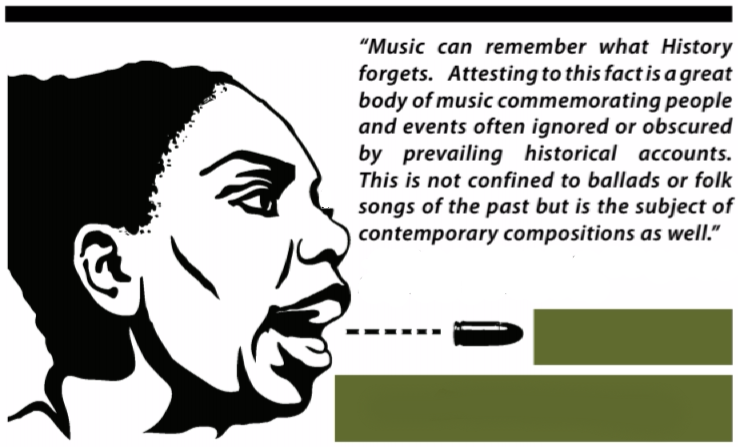
Image by Hope Asya
Music and memory have always been inseparable. After all, Memory is the name of the Goddess who was Mother of the Muses. The Muses, according to the poet Hesiod, "were nine like-minded daughters, whose one thought is singing, and whose hearts are free from care...who delight with song... telling of things that are, that will be and that were with voices joined in harmony." They called on Hesiod to sing their praises but they did so with a challenge: "You rustic shepherd, shame: bellies you are, not men! We know enough to make up lies which are convincing, but we also have the skill, when we've a mind, to speak the truth."
Read moreMirroring Hybrid Unpatriots

Nosotros quienes no somos patriotas
Nacimiento vaginal una razón por amar a madre
pero no fronteras jurídicas
Cantamos “La Bamba Rebelde”
We will cross, we will cross, we will cross