For Victor Serge, there was no life possible that could be separated from a commitment to the revolutionary struggle. And his life-spanned the first World War to the Russian Revolution, the rise of fascism in Germany and Spain, the rise of Stalin and the cataclysm of World War II. Serge lived through the heights of revolutionary triumph to the darkness of what he termed “the midnight of the century.” That commitment ranged from involvement in anarchism, syndicalism, Bolshevism, Trotskyism and what is best described as socialist humanism. Serge's revolutionary career saw him take up such varied roles as organizer, journalist, theoretician, militant, soldier, translator, a prisoner under at least five different regimes, secret agent, and a historian.
Read moreI am told that you raised your hand against yourself
Anticipating the butcher.
After eight years of exile, observing the rise of the enemy
Then at last, brought up against an impassable frontier
You passed, they say, a passable one.
Read moreLeonard Peltier could not be present at the exhibition of his artwork at the second Indigenous Fine Arts Market (IFAM) in Santa Fe, NM, held on August 20-22, because he's been incarcerated in the U.S. federal penitentiary system for the last 40 years. He's currently in Coleman (Florida), a known “gang prison,” a brutal and violent place subject to frequent lockdowns lasting not uncommonly for as long as a month.
Maybe next year?
Read moreAmong the more strikingly radical figures invoked by #BlackLivesMatter has been exiled Black revolutionary Assata Shakur. The former Black Panther, dubiously convicted “cop killer,” and wanted “terrorist” fugitive has become a recognized emblem in the movement, even though Assata herself, underground in Cuba, remains publicly quiet regarding the recent upsurge. Nonetheless, at demonstrations across the US, lines from Shakur’s autobiography have been turned into a kind of movement mantra.
Read moreWho cares about who gets caught jumping
over someone else’s fence?
Mutts will bark.
Porch lights will sweep small critters
into another darkness.
Big deal.
Nothing will be stolen.
Read moreOne could be easily forgiven for believing that theater is indeed “dead.” Every medium of culture and creativity struggles with issues of relevance and vitality, but the common conception of theater in particular seems to be one that has been most flagrantly geared merely toward parting tourists with their money. Of course, it’s not entirely true; the reality is far more complex. But the fact remains that there appears to be a gap between what we learn the live performing arts once were (or could be) and their present anodyne state. How is a play supposed to be relevant to working people? How can it be when it costs an arm and a leg just to go to one?
Read moreIt’s been a year since the death of Michael Brown, a year since the rebellion in Ferguson, a year since the Black Lives Matter movement began to shift the conversation in just about every avenue of American life. That shift can be seen in politics (from #BowDownBernie to Donald Trump’s threats to beat up protesters) and economics (the Black Youth Project’s embrace of the Fight for 15). It can also be seen, perhaps most obviously, in our culture — and in music, in particular.
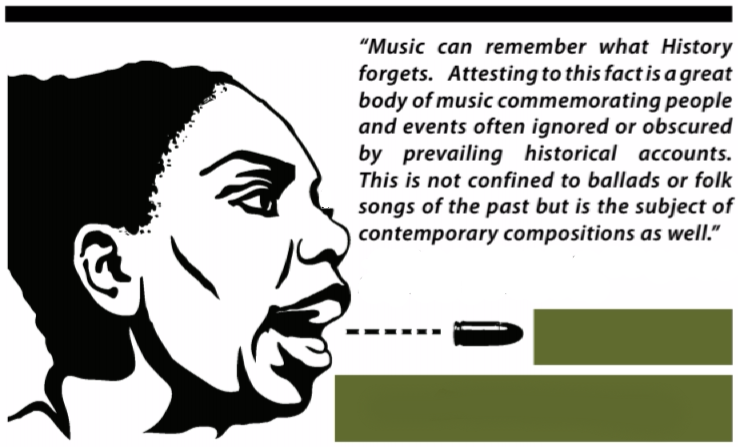
Read moreMusic and memory have always been inseparable. After all, Memory is the name of the Goddess who was Mother of the Muses. The Muses, according to the poet Hesiod, "were nine like-minded daughters, whose one thought is singing, and whose hearts are free from care...who delight with song... telling of things that are, that will be and that were with voices joined in harmony." They called on Hesiod to sing their praises but they did so with a challenge: "You rustic shepherd, shame: bellies you are, not men! We know enough to make up lies which are convincing, but we also have the skill, when we've a mind, to speak the truth."
Read moreNosotros quienes no somos patriotas
Nacimiento vaginal una razón por amar a madre
pero no fronteras jurídicas
Cantamos “La Bamba Rebelde”
We will cross, we will cross, we will cross
Read more"Flawless" is a dance performance piece about gender and sexuality choreographed for pre-professional dancers ranging in age from 13-17. We asked some of them to describe the piece and its development in their own words.
Choreography by Jenny Espino
Video editing by Aaron Garcia
Read moreIn late May 2015 Red Wedge editors Alexander Billet and Adam Turl spoke at the Left Forum in a workshop on "Neoliberalism and the Importance of the Radical Imagination." The above audio includes the presentations by Billet and Turl as well as the discussion that followed — touching on how neoliberalism has narrowed the radical imagination, the relationship of labor to culture, as well as possible practical and aesthetic strategies for contemporary art and culture.
Read moreShe was one of the many who came to me in those difficult days for advice and spiritual guidance.
I had seen her at a number of delegate conferences, and remembered having been struck by her pretty, rather intense face with its pensive but intelligent eyes.
Today her face was pale, the eyes even larger and sadder than usual.
"I came to you because there is no one else to whom I can go. I have been homeless for the past three weeks – I have no money. I must have work! If I don't get: some means of earning a living soon, there is only one thing left for me – the street."
Read moreOne of the delights of growing up politically lies in discovering one’s own traditions. In art they were nearly obliterated by Stalinism, declared redundant by the long post-war boom and generally buried in a "modernism" which was often apolitical and trite. It was exhilarating to unearth in Soviet Russia the most genuinely modern of modern art movements and Mayakovsky, the original "hooligan communist".
Vladimir Mayakovsky, the poetic loudspeaker of the Russian Revolution, came to socialist ideas with the enthusiasm of youth. He began to read Engels and illegal pamphlets under his desk-lid when he was 12. When later the same year his school was closed by Military Edict because of the 1905 uprising, he became chief school leaflet distributor. When he made his first contact with the illegal Bolshevik Party, he immediately presented them with his forester father’s shotgun. Aged 15, he was arrested in Moscow for helping to organise the escape of political prisoners from jail and was himself held in Novimsky Prison where he began to write poems. For the following 20 years he served the Revolution as a poet-agitator with the same audacity and passion. And when he shot himself in Moscow in 1930, he died a Bolshevik, brandishing his poems:
Read more♫ when i break up with my boyfriend
what i need is my best friends
when i break up with my boyfriend
what i need is my best friends
girls and guys / exes and fly / babes of the future / celebrated witches / queer/androgynous no /
frontiers / love is / in / between
when i break up with my bf
and i’m driving thru the desert alone
Read morefrom the street: a wounded howl,
fuck the police and it echoes from the prisons,
fuck the police
the anger which vibrates somewhere low
in their chests, weighted down
by one too many
unwarranted traffic stops
when the tail light
wasn’t out, and the time
they killed that person--
no, not Mike Brown, the other time. no,
Read more1.
a bird built a nest
in my grandfather’s
up-turned welding goggles
the day after
he died
I never told
my grandmother
this, but
the dead
are dead
and the living
are dead
and
by August
the nest
was empty
Read moreIf the grand conversation around race were to be neatly divided into “before” and “after” Ferguson, then Kendrick Lamar’s To Pimp a Butterfly would have to be regarded as something of an artistic landmark, a stunning musical distillation of the post-Ferguson mood. I am inclined to agree with Rolling Stone’s Greg Tate when he writes: “Thanks to D'Angelo's Black Messiah and Kendrick Lamar's To Pimp a Butterfly, 2015 will be remembered as the year radical Black politics and for-real Black music resurged in tandem to converge on the nation's pop mainstream.”
Lamar’s album has far exceeded all expectations. In its first day of release, To Pimp a Butterfly became the mostheavily-streamed album in Spotify’s history, racking up a reported 9.6 million listens on that day alone. It’s the first hip-hop or R&B album since Beyoncé to spend multiple weeks on top of the Billboard charts, and has already been certified Gold.
Read moreI am not sure
Truly, she was nothing more than just a purse
But when lost, there was a problem
How to face the world without her
Especially
Because the streets remember us together
The shops know her more than me
Because she is the one who pays
She knows the smell of my sweat and she loves it
She knows the different buses
And has her own relationship with their drivers
She memorizes the ticket price
And always has the exact change
Once I bought a perfume she didn’t like
She spilled all of it and refused to let me use it
By the way
She also loves my family
And she always carried a picture
Of each one she loves
Read moreBlack Future Month is here.
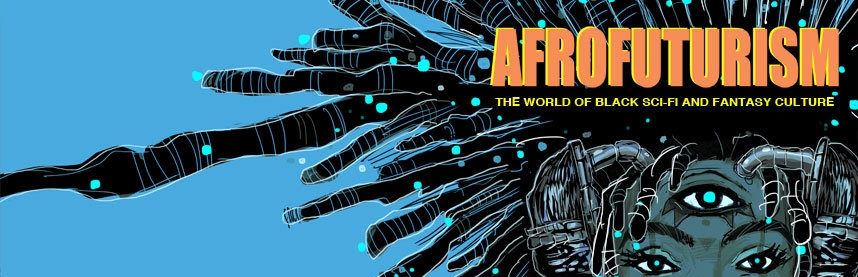
Black Future Month is the name film curator Floyd Webb and I selected as the title for our February Afrofuturism film series each Thursday at the SMG Chatham Theater in Chicago. Situated in the Chatham neighborhood on the Southside of Chicago, Floyd and I, as creators of Afrofuturism849, aimed to introduce curious audiences to the range of sci fi works and documentaries highlighting ideas, stories and people within the sci fi, speculative fiction, and science worlds. We showcased the Cameroonian film Les Saignantes about women in a corrupt mystical and futuristic Cameroon. We showed “White Scripts, Black Supermen” on the early black comic heroes and brought out Turtel Onli, father of the Black Age in Comics, comic creator Jiba Molei Anderson and Institute of Comic Studies cofounder Stanford Carpenter to discuss the project. Amir George, co-curator of the Black Radical Imagination, a series of experimental shorts introduced his works and several physicists and astronomers were on hand to discuss our science documentaries. While displaying my book Rayla 2212, a story that follows a war strategist on a former earth colony 200 years into the future who time/astral travels, one attendee remarked that she had no idea that black sci-fi and comics existed.
Read moreThe following is the lead editorial from Red Wedge's first full print issue, which is being sent to the printers shortly. Copies of Issue One can be ordered at the Red Wedge shop.
* * *
In August 2012 a handful of Chicago-based Marxist art junkies launched Red Wedge. The moment was distinctive: Tunisia, Egypt, Occupy Wall Street, the Indignados in Spain, general strikes in Greece and South Africa. Our aim was to try to pull together the artistic and creative flourishes that came with the social and political upheavals: the music and poetry of Tahrir Square, the painting, sculpture and performance of Occupy. It was impossible to ignore the transformation of public space when working-class people took it over. The static reminders of authority and alienation became living breathing carnivals of resistance. It was our belief that this indicated a new audience eager to discuss the aesthetics of rebellion and ready to explore the intersection between art and radical theory. We hoped our website might be a humble contribution to building and cohering a new cultural resistance.
Read more